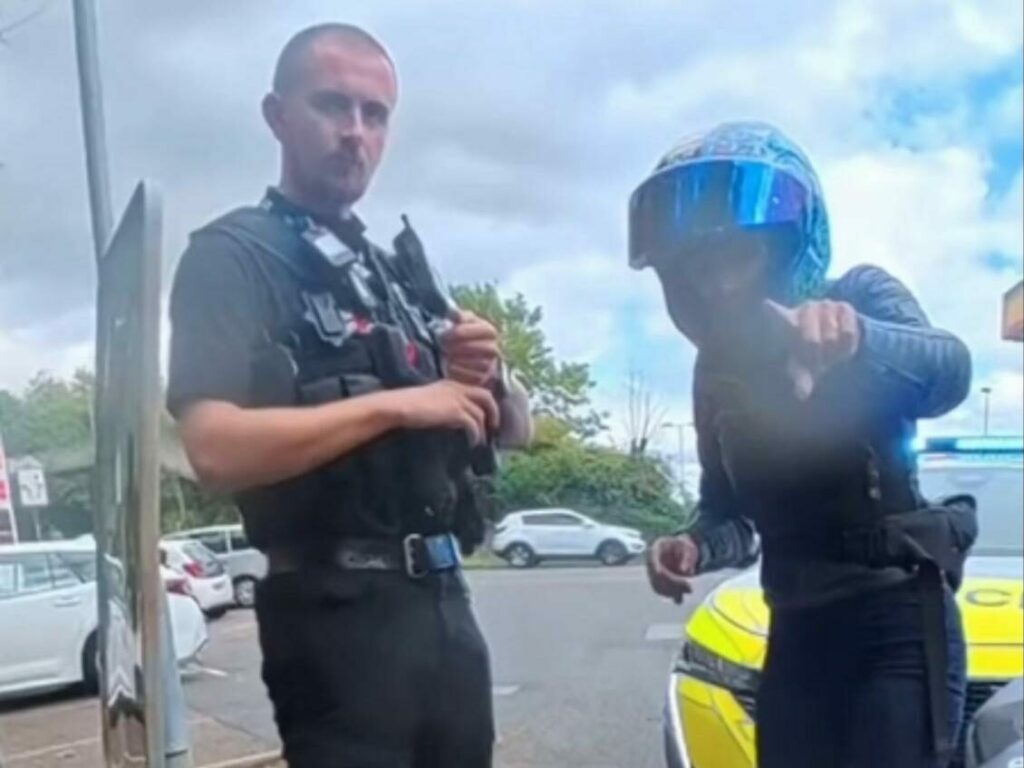

- Since 29 June 2026, police in England and Wales can seize a vehicle under Section 59 on the spot — the warning that used to come first has been abolished.
- From 22 July 2026 a seized vehicle can be sold or scrapped after just 7 days, and getting it back costs £192 plus £13 to £26 a day in storage.
- And one motorcyclist’s 360-degree camera has captured exactly how the new power is being used at the roadside.
The officer’s opening words, as the motorcyclist pulled over, were: “What’s that riding about?”
Within a minute he had told her: “I’m gonna be taking the bike.” When she asked what she had done, he said she had been riding “in an anti-social manner” — “constant revving”, “speeding all the way around other cars” — and named the power he was using: Section 59 of the Police Reform Act 2002, “as amended this year”.
No warning had been given and no speed had been recorded — and under the law as it has stood since 29 June 2026, neither is required.
What happened next is the reason every Driver should know what Section 59 now allows.
The Safeguard That Quietly Disappeared
Section 59 has been on the statute book since 2002. It lets a uniformed officer who has reasonable grounds to believe a vehicle is being driven carelessly or inconsiderately, in a way that causes or is likely to cause “alarm, distress or annoyance”, order the Driver to stop and seize the vehicle. No conviction is needed, and no Court is involved.
For 23 years there was a safeguard built in. The officer had to give a warning first, and could only seize the vehicle if the same thing happened again within 12 months.
Section 8 of the Crime and Policing Act 2026 removed that warning, with effect from 29 June 2026. The Home Office’s own circular explains the purpose plainly: the change “will make it easier and quicker for police to seize vehicles”.
Then, on 22 July 2026, separate regulations cut the time police must hold a seized vehicle before selling or scrapping it from 14 days to 7.
So within the space of a month in 2026, the distance between one officer’s opinion at the roadside and your vehicle being crushed shrank to a week.
“Conclusive Proof” — Without a Speed Reading
Back to the roadside, in a video we were sent in 2026. The officer had three complaints. The number plate was “far too small”. The rider had been “revving past people”. And he had not been able to take a speed reading.
Not, he said, because she was within the limit, but because he “couldn’t get close enough”. He told her he had needed to go “significantly higher than the speed limit” to catch up with her, and that this was “conclusive proof” she had been speeding.
The rider pointed out that her bike has a quickshifter and auto-blipper — it matches engine revs automatically on every gear change — so what he had heard as revving was the machine doing what it was built to do. His answer: “I disagree. No, no, no.”
Then she told him the whole ride, and the whole conversation, had been recorded on a 360-degree camera mounted on the bike, and offered to show him the footage.
A few minutes later he closed the stop with: “I’ll leave it as a bit of a warning for today. I’m not gonna take the bike.”
The footage she later published shows four overtakes and no revving. By her account she had ridden with particular care to stay inside the limit, precisely because she knew a police car was behind her.
Don’t miss a story: join the free DriveProtect newsletter — straight-talking updates for British Motorists.
What a Section 59 Seizure Actually Costs You
Had he followed through, here is what the rider would have faced. The statutory release fee in England and Wales is £192, plus storage of £13 a day for a motorcycle or £26 a day for a car.
Fail to collect within 7 days and the police can sell or scrap the vehicle. Their charges come out of any sale proceeds first; if nothing is left to sell, the disposal fee is £64 for a motorcycle and £96 for a car.
And there is no hearing at which to argue any of it. Section 59 is not a prosecution but a seizure, and the only “trial” is the conversation at the roadside — which is exactly why what this rider did next mattered so much.
What the Camera Changed
The British Motorcyclists Federation’s guidance on the 2026 rules is blunt: a small number plate does not, on its own, give police a Section 59 power to seize a motorcycle, and nor does a loud exhaust. A non-compliant plate can earn a separate fine, but it is not grounds for taking the bike.
So of the officer’s three complaints, one was not grounds for seizure, one was contradicted by the footage, and the third was an admission that he had no speed reading at all.
Without the camera, none of that would have counted for anything. It would have been her word against his, with the bike already on a recovery truck and the 7-day clock running. With it, the seizure became a warning.
That is the uncomfortable lesson of the new Section 59. The safeguard that used to protect Drivers — the warning — has gone. The only safeguard left is the one you bring with you.
If It Happens To You
A Section 59 stop rarely ends with the seizure alone. The same roadside encounter can produce a NIP for careless driving, speeding or a plate offence — and that is where the paperwork, and the points, begin.
DriveProtect™ Members don’t deal with that paperwork alone. From the day a NIP arrives, Members get direct access to a specialist Speeding Solicitor who reviews their case and advises them exactly what to respond — and when an officer’s account is contradicted by the evidence, that is precisely the moment expert help pays for itself, for a fraction of the normal cost of legal help.
The war on the British Motorist, straight to your inbox
Join the free newsletter — straight-talking updates on speed cameras, enforcement, and your rights as a Driver.
Join the NewsletterGot a NIP or points on your licence right now? See how DriveProtect Membership works — a specialist Speeding Solicitor in your corner from £25/month.